|
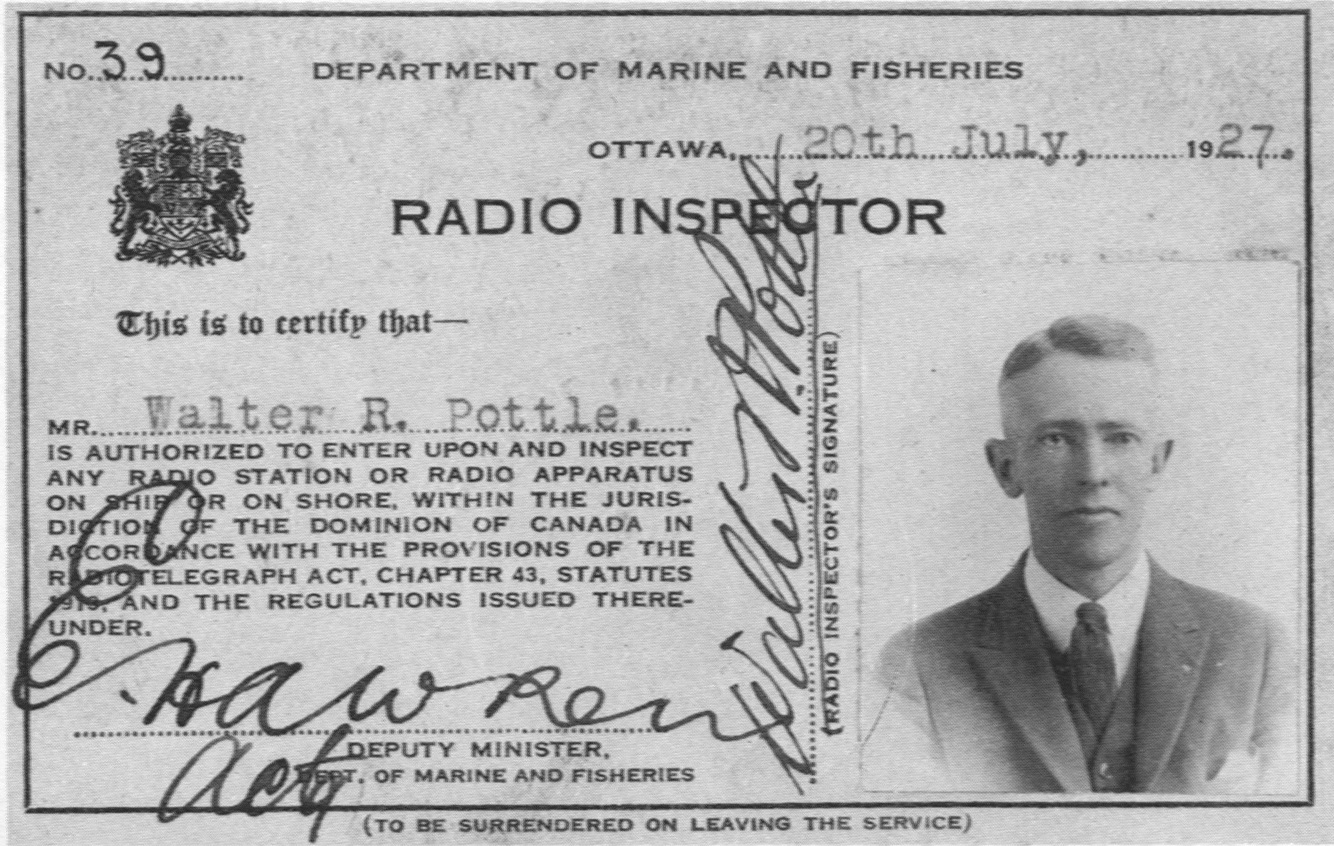
Radio Inspector Card No. 39 issued to
Walter R. Pottle on July 20th, 1927 by the Department of Marine and
Fisheries.
Click on photo
to enlarge
Source: From Spark to Space
|
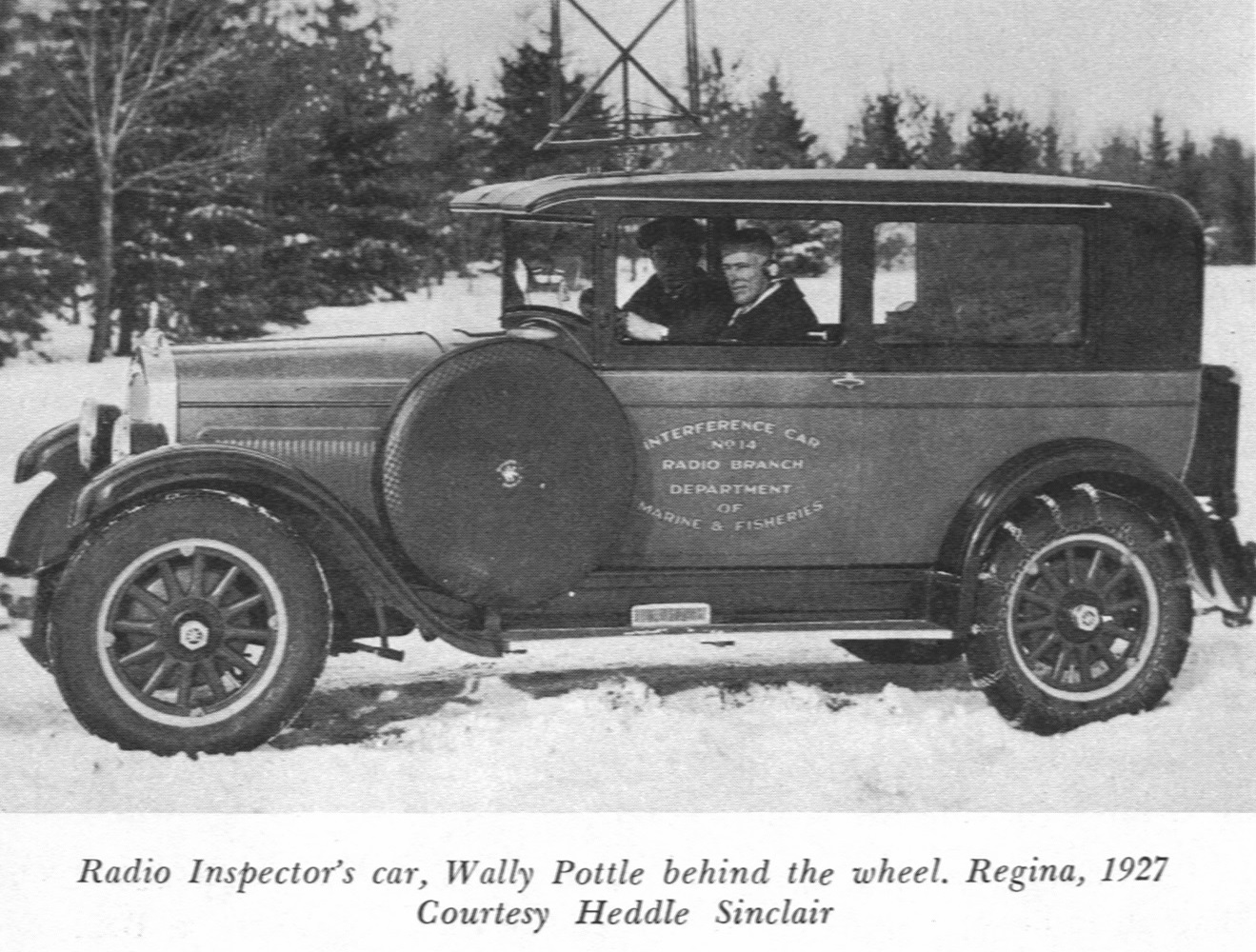
Radio Inspector's car in Regina,
Saskatchewan in 1927. Behind the wheel is Wally Pottle.
Click on photo
to enlarge
Source: From Spark to Space
|
|
You can click on each photo to
enlarge it. Use the back button of your computer to return to this page. |
An article which appears in the newspaper The Sun of Swift Current,
Saskatchewan, sometimes in the 1920s
RADIO EXPERTS IN CITY TODAY
Inspector Pottle
of Regina Will Personally Superintend Hunt For Local Trouble
A thorough investigation in an attempt to clear up
the local interference that has been bothering owners of radio receiving sets is
under way in the city today under the direction of Chief Radio Inspector W.R. Pottle of Regina and his
assistant J.C. Stephens of Moose Jaw, who arrived yesterday afternoon with the
now well known "radio car" of the Department of Marine. Co-operation is being
given the experts by the city electric light department and radio dealers.
Superintendent Sam Barker of the C.P.R. telegraphs is also here in this behalf.
A systematic checkup is being made and the radio men will be here until some
conclusion is reached as to the cause of the trouble.
"I am not making any rash promises" stated Mr. Pottle to The Sun, "for radio is a
peculiar thing; however, we will do our best to find the cause of the
interference and clear it up as soon as possible."
The Department of Marine presently has fifteen radio
cars and each is specially equipped for locating inductive interference. Each
one has an eight tube superhetrodyne receiving set designed for the purpose by
the Department. The loop aerial (which has caused a great deal of interest in
the locality) is very directional and works on the principle of the direction
finding apparatus used on ships. This gives the operator the direction from
which the interference originates. The operator first gets an angle at one point
and then proceeds to another point and where the two lines intersect is
approximately the source of the interference.
A step installed on the rear of the car and a sledge
hammer are used in what is known as the "sledge hammer test". A man rides on the
step, the car stops at all poles carrying suspected equipment, the pole is
struck and the result is noted by the man at the radio receiver. Any loose
connections on the pole will result in a click or roar in the radio receiver.
The car also carries many scientific instruments for
testing and recording, as some of the currents which cause radio interference
are very small. In some cases the amount of current causing the loudest
interference if measured would not light a pocket flashlight. It can cause
interference which will radiate for many miles along a power line. The car is
really a travelling radio laboratory and has many types of surge traps and tools
and materials to be used in difficult or stubborn cases. Household electrical
appliances of all kinds are potential sources of radio interference particularly
if they are not in good condition. The investigators become expert at telling
what types of apparatus is causing interference by hearing the noise that it
makes in a radio receiver.
Radio Licences
Mr. Pottle
asked The Sun to bring to the attention of radio owners in Swift Current the
fact that at the same time a checkup will be made for those who have failed to
pay their annual license fee of $1.
Those who have not complied with the law in this respect are liable to
prosecution and are urged by the department to procure their licenses without
delay. It is pointed out that the fiscal year ends March 31st of each year, and
licenses are valid from the date of issue until that time when they must be
renewed if the set continues to be operated. Accordingly those who have recently
purchased sets are reminded that they must take out a license to cover the
remaining months of the fiscal year.