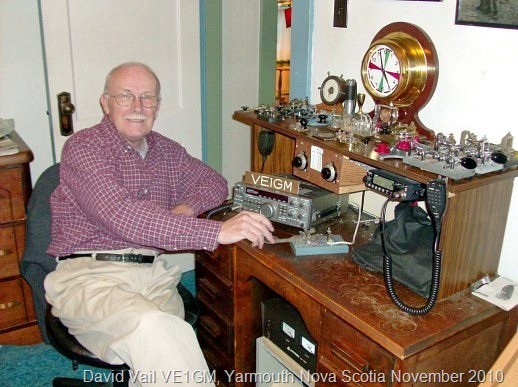
 “I
was born in Charlottetown, PEI. Early in 1956, DOT had an urgent need for
operators and they sponsored a course at the vocational school in Saint John,
NB. It was normally a 2-year course but they squeezed it down to 10 months in
order to get us on the job more quickly. There were about 30 men in the course
and about 15 of us graduated on the first writing, some of the others went back
to the school in 1957 and graduated in that year. We were paid $150.00 per month
while training and had to agree to stay with DOT for 3 years. 3 years sounded
like a long time when you were 18 years old, but now 54 years have passed and
many of my classmates and all of the instructors are silent keys.
So
I left home at age 17 to take that commercial radio operator’s course in Saint
John, NB and graduated in December 1956 with a Second Class Certificate of
Proficiency In Radio which was upgraded to First Class in 1977. I then went to
Moncton, N.B. airport for a couple of months of training as a surface weather
observer, then posted to Yarmouth, NS Aeradio (CYQI) as radio operator/weather
observer. This was a 2-man station open 24/7. From there, I was transferred to
Yarmouth Marine Radio (VAU) then to the LURCHER lightship (VGA) anchored 17
miles offshore. Then it was back to VAU where I was transferred to Seal Island
Radio Beacon (VGY), a 1-man station for 14 months. It was back to VAU then
transferred to the Canadian Government Ship “C.D. Howe” (CGSS) for the 1959
Eastern Arctic Patrol, a 3-month voyage.
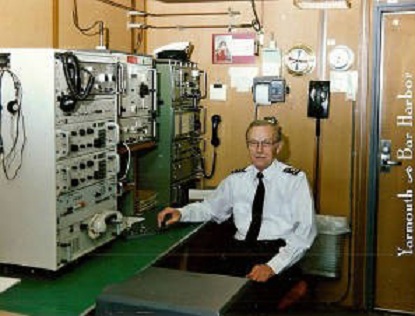 Returning to the Maritimes, I was stationed to Fredericton Aeradio as r/o and
weather observer. All these transfers and postings happened over a 3-year
period. When a permanent position on the M.V. “Bluenose” (VDND) became open I
applied for it and was accepted. I joined that ship on Boxing Day in 1959 and
remained in that service until early retirement in 1993.
In
the Yarmouth-New England ferry service I served on VDND, on the M.V. “Marine
Cruiser” (GSOC), the M.V. “Marine Evangeline” (C6CA) and later VCQK and finally
on the second “Bluenose” (C6DZ). The “Marine Evangeline” had two call signs
because she changed from Bahamian to Canadian registry. In the spring of 1957 I
joined the Yarmouth ARC where I'm still a member and have helped train many new
hams over the years. When I.C. instituted the Delegated Examiner program in the
early 1990s, I became an examiner for the various amateur qualifications. In the
late 1970s, our club took in our first “White Caner” who was later followed by
about 10 others, some of whom are now silent keys. Nowadays I work a bit of HF,
mostly 80 and 20 meters some CW and some SSB. Still take part in Field Day and a
couple of local HF contests. Living on a small lot I could only put up a G5RV
and a 2-meter vertical, so no powerhouse operation from this QTH.”